Celebrating International Day of Women and Girls in Science
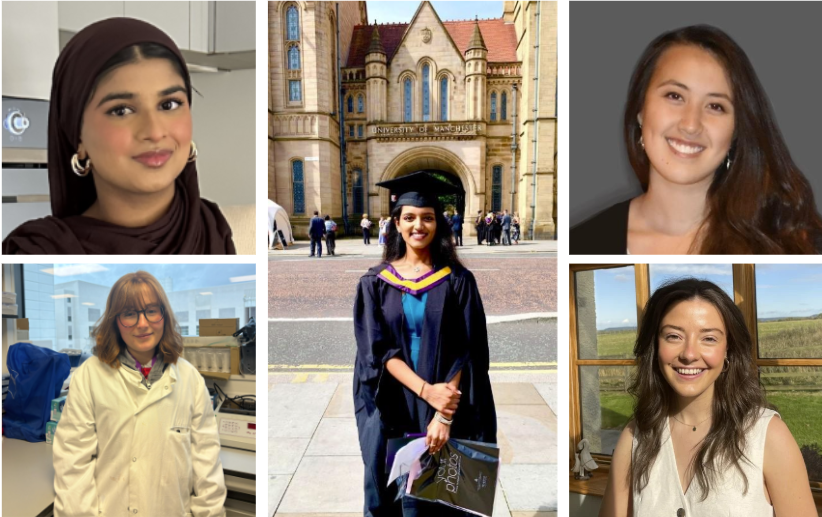
We are celebrating five brilliant women shaping the future of neuroscience and stroke research across the Geoffrey Jefferson Brain Research Centre.

Ivy Usansky, Final year PhD student
I am in my final 6-months of my PhD in Neuroscience and Immunology, investigating the effects of obesity on ischaemic stroke.
I started my love of science in my AP biology class in an American high school in New Jersey. From there, I applied to do an undergraduate degree in Biomedical Sciences at King’s College London and fell in love with the biology of the human body and healing diseases. And naturally, after my undergraduate, I did the typical move that a lot of students do to a pharmaceutical company to help create medicines for people around the world that need them. However, my role was maintaining Quality Assurance for our drugs on market, and I just did not feel like I was doing enough “science”. Each day was hours of meetings and project plans, but I missed the science that I had fallen in love with as a bright-eyed uni student. So I quit my job and applied to do a PhD at the University of Manchester in brain research. And here I am immersed science every day, but I also get out so much more. I have to plan out my experiments using ideas from literature or other experts in my field. When those experiments go wrong or give unexpected results, I have to pivot and come up with new solutions on the fly. I am never bored and always excited by the next potential challenge. And I encourage any young go-getters to try the same, if you enjoy working through challenges and finding creative solutions.
After my PhD ends, I will choose to stay in research and might even choose to go back to the pharmaceutical industry (this time with more scientific-involvement). But I believe that is the point: no one path in the science field is correct. At each stage, you can make it whatever you want to. And you won’t know that you do or don’t love something until you try it. So do what you find interesting at the time, and you’ll be able to turn it into your dream role.

Aishah Ahmed, Stroke Research Assistant, Northern Care Alliance NHS Foundation Trust
When I stepped into my role as a Stroke Research Assistant five months ago, I knew I wanted a career where science directly improves people’s lives. What I didn’t expect was how quickly I would see its real‑world impact. Working in acute stroke has shaped my confidence, my skills and the way I see research as part of everyday clinical care.
I was drawn to a role where science meets people. The DIAGNOSIS study, which looks at using fast, point‑of‑care biomarker testing to identify stroke subtypes earlier, has shown me how research can be both rigorous and deeply personal. Each day I support immediate clinical assessments, on‑arrival biomarker testing and rapid communication with stroke teams. It’s fast paced and sometimes overwhelming, but it has taught me how to make decisions quickly, communicate clearly and stay calm when everything is moving at speed.
One aspect of the job I value most is the time spent reassuring patients who arrive frightened or uncertain. Simple explanations about what is happening and how research might improve stroke care in the future can make a real difference in those first moments. It reminds me that science isn’t abstract — people live through it.
Working in this environment has also changed how I see my place in science. I’ve met women leading across paramedicine, nursing, research and coordination, all showing how many different pathways there are into this field. Their example has helped me find my own voice and confidence in a role that carries real responsibility from day one.
As I continue in this post, I’m motivated by knowing that DIAGNOSIS is part of a wider movement toward faster, more accurate stroke diagnosis and better early treatment. Being involved in work that could shape future care is something I never imagined so early in my career. For any young woman considering science, whether clinical, research‑focused or somewhere in between, there are many ways in, and each one offers the chance to make a meaningful difference sooner than you might expect.

Nima Geemon, 3rd year PhD student in the Brain Inflammation Group
My project is looking at using zebrafish as a tool to study the NLRP3 inflammation in intracerebral haemorrhage. I am drawn to science – and neuroscience in particular – because it combines curiosity with impact. I enjoy discovering new things and being at the forefront of cutting-edge research, where each question pushes the boundaries of what we currently understand. Researching about intracerebral haemorrhage allows me to contribute to solving real-world problems, while constantly engaging in analytical thinking and problem-solving. What motivates me most is the dynamic nature of the field: no two days are the same, and each day presents a new challenge, idea, or insight that deepens my understanding of the brain and its complexity.
I would strongly encourage women into science because science shapes the future. Science is basically getting paid to be curious – asking questions, trying things out, and discovering how the world works. Science rewards critical thinking, creativity, and resilience, and provides a space where ideas, evidence, and problem-solving matter more than background. As I mentioned earlier, science is rarely repetitive; it offers constant learning, new challenges, and the opportunity to see a drug move from bench side to bedside.
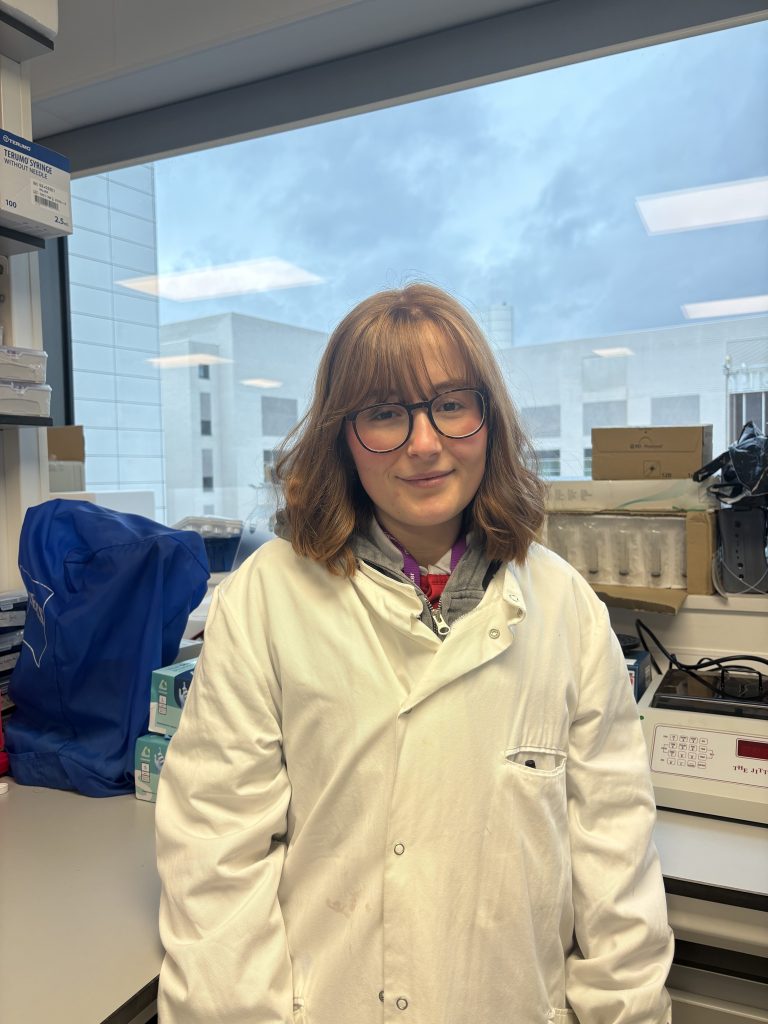
Abbie Williams, Masters student
Starting my journey into science, I chose a Biomedical science as an undergraduate degree, which provided me with a broad foundation in human biology and disease. Through this course, I explored a range of pathological process and found interest in neuroinflammation. This interest developed into my current research area on modulating neuroinflammation by blocking IL-1 in ischaemic stroke, a serious illness that can cause acute and long-term devastating effects.
Science has always been a passion of mine particularly biology as it defines the fundamentals of living organisms. I value the aspect of continual learning, bringing new challenges and questions every day. Being part of scientific research allows me to contribute to knowledge that may have lasting impact beyond my own work. With stroke affecting approximately one in four people worldwide, contributing to research in this area feels both relevant and meaningful.
What I enjoy most about science is its constantly evolving nature. Research requires adaptability and critical thinking. There is a collaborative nature in the laboratory environment where shared expertise and problem-solving drive progress. Seeing female role models in research settings has been especially motivating, highlighting how collective effort can piece together complex biological questions and how invaluable multiple viewpoints are in research.
I would encourage other women and girls to consider a career in science because many of society’s greatest challenges from disease to climate change require diverse perspectives and inclusive thinkings. I hope that occasions such as the International Day of Women and Girls in Science continues to inspire the next generation to see science as a field where they belong and can thrive.
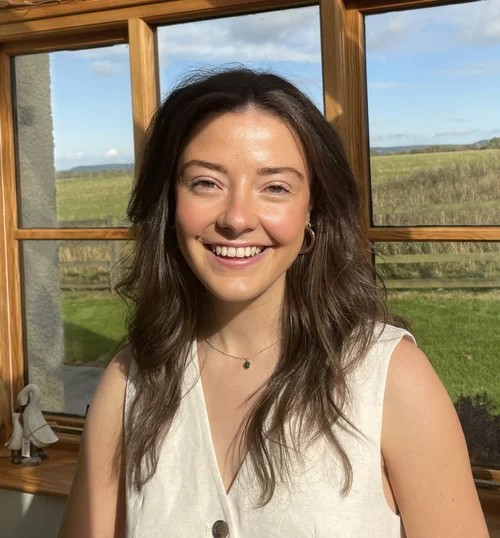
Abi Bennington, British Heart Foundation PhD Student
My research focuses on understanding and targeting the inflammatory response that follows intracerebral haemorrhage (ICH). ICH is a devastating type of stroke caused by blood vessel rupture in the brain and has no specific treatments. The neuroinflammatory response post-ICH is a key driver of brain injury, but several aspects of this response are essential for blood clearance and brain repair. My project investigates ways of limiting harmful effects of inflammatory cells and promoting beneficial, repair mechanisms.
I’ve always loved science and shortly into my undergraduate degree I realised research offered the chance to be curious about diseases whilst also having an effect on patient outcomes. What I enjoy most about my field is the process of discovery – asking questions that don’t yet have answers and working to uncover something genuinely new. Being part of a larger team working towards an important shared goal, while also having the freedom to shape my own project around my interests, is something I find especially fulfilling.
The idea that this work could eventually help patients and translate into clinical impact is a huge motivator. I would strongly encourage anyone interested in science to consider a research pathway. It gives you the opportunity to think creatively, solve meaningful problems, and work alongside world-leading researchers – all while contributing to knowledge that can make a real difference.


Address
Geoffrey Jefferson Brain Research Centre
Clinical Sciences Building
Northern Care Alliance
NHS Foundation Trust
Salford
M6 8FJ
Email: GJBRC@manchester.ac.uk
Connect with us


0 Comments