

Five months on the front line of stroke research: my experience working on the DIAGNOSIS study
By Aishah Ahmed, Stroke Research Assistant, Northern Care Alliance NHS Foundation Trust
Five months into my role as a Stroke Research Assistant, I have gained a first-hand appreciation of the impact stroke research can have and the unique challenges and rewards of recruiting patients in an acute setting. The phrase “time is brain” has never felt more real.
Introducing the DIAGNOSIS study
Led by Professor Adrian Parry-Jones, part of the stroke theme in the Geoffrey Jefferson Brain Research Centre, and the Manchester team from Northern Care Alliance NHS Foundation Trust, the DIAGNOSIS study is exploring whether combining clinical signs with rapid point of care blood biomarker tests can help identify stroke subtypes sooner, particularly intracerebral haemorrhage and large vessel occlusion.
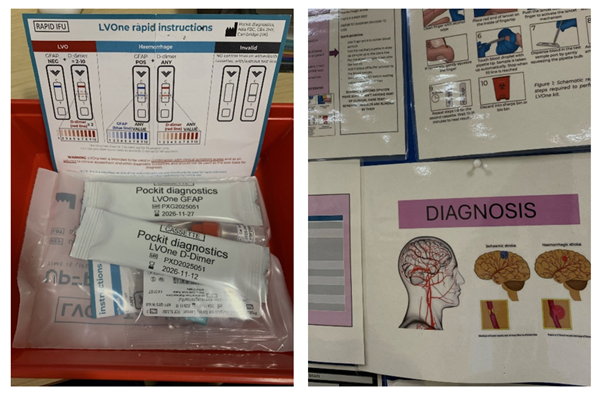
These biomarkers – GFAP (linked to brain bleeding) and D-dimer (associated with clotting) – are tested immediately using Upfront Diagnostics’ handheld device, with samples taken before hospital imaging. It is a small but potentially game-changing shift in the early stroke pathway. What we ultimately hope to achieve is accurate diagnosis of stroke subtypes in the ambulance so patients can be directed to the right place for immediate care (especially LVO for thrombectomy), and to test whether some treatments could safely be delivered in the ambulance for conditions such as intracerebral haemorrhage.
? More information: Improving stroke diagnosis: A study using blood tests and clinical information to quickly identify stroke types in suspected stroke patients
Why it matters
If clinicians could identify stroke subtype accurately before CT scanning, it could:
- Enable more targeted, faster treatment decisions
- Improve allocation of specialist resources
- Support more personalised and efficient stroke pathways
- Ultimately improve patient outcomes
In emergency stroke care, every minute counts, and earlier insight could make those minutes work harder for our patients.
Frontline research
The DIAGNOSIS study is a diagnostic accuracy (observational) study carried out with suspected stroke patients arriving via ambulance. Working closely with North West Ambulance Service (NWAS) and A\&E colleagues, we carry out:
- Immediate clinical assessment
- Point of care biomarker testing using handheld devices
- Rapid communication with clinical teams to ensure research never delays essential care
Seeing these rapid tests used in real time has shown me just how “front line” research can be.
Balancing research and acute care
Being one of the first people a patient sees when they arrive by ambulance can feel daunting, and the pressure, pace, and balancing research alongside the clinical care pathway is challenging.
There is often a lack of education around stroke and taking the time to help patients understand what is happening not only reassures them but also empowers them to be active participants in their care. One of the most rewarding parts of this role has been explaining the research to patients who arrive scared, confused, or unsure about what is happening to their body.
Stroke education is sometimes overlooked in the rush to get patients to CT quickly, but even a brief pause to explain:
- how strokes occur
- why rapid intervention matters
- how biomarker testing could shape future diagnosis
…can genuinely make a difference. It reassures patients, builds trust, and helps them understand and participate in their own care.
Our progress so far
The three hospitals involved in the study are Salford Royal, Stepping Hill, and Fairfield General Hospital, where we have now successfully recruited our first 10 patients. Working with NWAS crews and the A\&E team has given me real insight into:
- the challenge of establishing accurate onset times
• the importance of seamless communication
• the skill involved in rapid triage
• how essential efficiency is when minutes make a difference
These experiences have deepened my appreciation of the entire stroke pathway and everyone who contributes to it.
Looking ahead
The DIAGNOSIS study reflects a wider movement in emergency medicine toward biomarker guided triage. By gathering high quality evidence early in the pathway, we hope to support faster, more robust stroke diagnosis and ultimately improve patient care.
Being part of this study has reminded me why stroke research matters, and being able to support both research and care, side by side, has been one of the most fulfilling parts of this role so far.
Address
Geoffrey Jefferson Brain Research Centre
Clinical Sciences Building
Northern Care Alliance
NHS Foundation Trust
Salford
M6 8FJ
Email: GJBRC@manchester.ac.uk
Connect with us


0 Comments