Dreaming: Beneath the Surface
Dr Yolanda Ohene, Wellcome Accelerator Award Research Fellow, talks about a recent event she organised to discuss health inequalities and underrepresentation in research for Black communities.
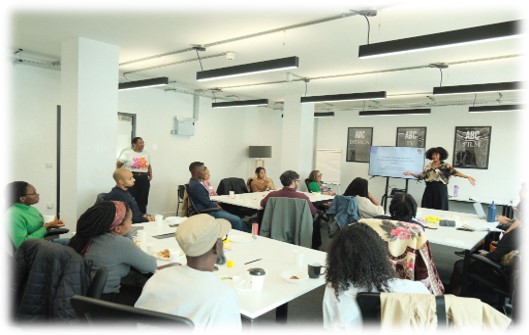
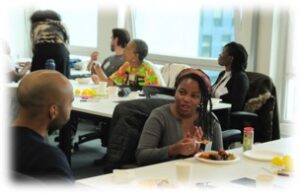
On Friday 12 June, I invited 13 black researchers, artists and community organisers to dream about health equity for Black communities. The event was partly motivated by the underrepresentation of Black communities in research despite conditions disproportionately impacting Black communities.
We ate good food, made new connections, explored needs and resources and considered creative and expansive ways to tackle health inequalities and underrepresentation in research. The event development was supported by patient and public involvement and engagement consultant Hana Ayoob and discussions were facilitated by community engagement specialist Deanne Naula.
A change in plans
We originally planned to hold an event for members of Black communities in Manchester to explore brain health and barriers to taking part in neuroimaging research. As we moved forward organising this event, it became clear I didn’t have the public engagement expertise and established community links necessary to hold such an event with the care and trust required to avoid being extractive and having minimal positive impact on communities.
Taking a step back to work with other Black researchers who are also committed to health equity, community organisers with well-established networks of their own and artists with practices linked to this area, felt like a better next step. The core aims of the day were to:
- Provide an opportunity to make new connections
- Explore needs and resources
- Dream about future possibilities
Discoveries
A loosely held plan
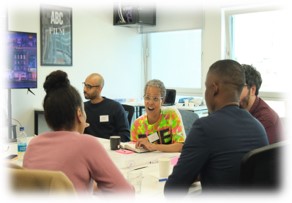
Conversation flowed from the moment people began arriving, as they immediately began making connections and discussing ideas. Food was ready slightly later than planned, but we recognised the informal conversations were just as important as the more structured discussion. Having a skilled and flexible facilitator was essential to being able to fold the agenda loosely and to remember the main aims of the day.
Making connections
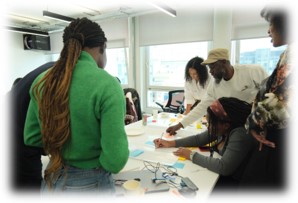
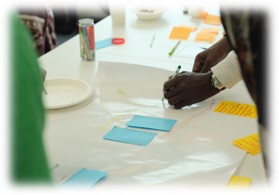
The first structured activity of the day asked individuals to think about their own networks before starting to create sprawling spider diagrams linking shared connections together. There were surprised exclamations of shared connections throughout the exercise, and as groups fed back to the main room these exclamations continued. There was recognition of the strength which is found within these networks and how they allow us to do good work.
Resources and needs
The second discussion of the day focused on what individuals needed and what they could offer to the group. There was a unanimous recognition of needing more funding for this work and in particular more sustainable funding which would allow for intergenerational work over decades. There was discussion of what a community endowment fund would look like. We also discussed the possibility of having these conversations with funders in the room.
Other needs which were identified included:
- Authentic and trusted community spaces – building and maintaining trust takes time but can be easily and quickly be lost.
- Time and recognition for this work, with emphasis on increased awareness of existing events or research activities
- Mentorship, sponsorship and training
- Moving beyond extractive community work
Resources found within the group included:
- Hopefulness, particularly with those with strong community connections and relationships
- Being seen as a trusted organisation or individual
- Access to health-related funding
Valuing people
We offered attendees an £150 thank you and travel expenses for attending the event. While navigating the university system was tricky for these payments, I thought this was important to renumerate the participants for their wide expertise and lived experiences which often goes unrecognised.
We enjoyed a buffet of Ghanaian food for lunch which was truly a highlight of the event. Lots of people arrived early to make the most of the food, and it became a further opportunity for connection as attendees enjoyed the flavours and shared nostalgia.
Not trying to be the solution
We were conscious that this event was a part of a much bigger picture, building on an existing legacy. Attendees included people who were relatively new to the space as well as those who had been doing community work and equity work for decades.
It was important for us to recognise and acknowledge these conversations had taken place many times before and how important it was to learn from previous conversations. This recognition is such an important part of continuing conversations and learning from each other, rather than fostering resentment.
An invite-only space
We made the decision to run the event as an invite only space, where the majority of attendees were from Black communities. I invited people who I admire and I am inspired by in the research space, and I also reached out to incredible community organisers and artists to learn from them and bring some creativity into the space.
There were more similarities than differences in the room between people working in different spaces. Multiple attendees shared they had said yes to coming to the event because of our previous interactions, which highlighted the power of building on existing connections.
Attendees feedback that they felt safe and were grateful to hosts and facilitators for creating this space, to be able to think more deeply about public engagement work and how to better serve community through science.

Next steps
The event has laid the foundations for future work, starting and continuing so many important conversations. It also builds on a long legacy of work, and a gentle reminder that community work and our scientific endeavours are intertwined. As I move forward, I hope to continue to build on community and creativity in my scientific practice.


Address
Geoffrey Jefferson Brain Research Centre
Clinical Sciences Building
Northern Care Alliance
NHS Foundation Trust
Salford
M6 8FJ
Email: GJBRC@manchester.ac.uk
Connect with us


0 Comments