
International Women’s Day 2026
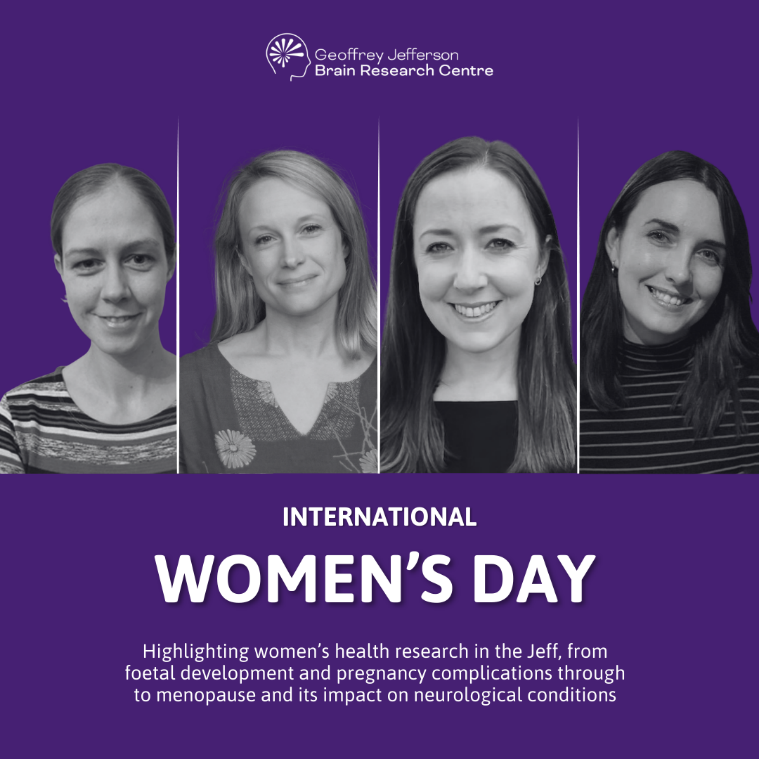
This IWD 2026 we celebrate the work that some of our fantastic researchers here at the GJBRC are doing to improve women’s health.

Stephanie Worton, Consultant Obstetrician
1 in 20 pregnant women develop the complication pre-eclampsia. This can cause dangerously high blood pressure and organ damage and is one of the leading causes of maternal death worldwide. As an Obstetrician caring for women with pre-eclampsia, I am regularly faced with difficult decisions about delivering babies very preterm because we do not have medications that can treat the underlying disease. My research group use live-cell imaging techniques to study small arteries donated by women having caesarean sections to understand exactly why women have high blood pressure. Our work so far has identified problems with tiny calcium signals, called ‘calcium sparks’, in arteries from women with pre-eclampsia. We are trying to develop new treatments that can restore calcium sparks that could be used to treat pre-eclampsia to improve the health of women and their babies.
We also know that women who have pre-eclampsia are more likely to develop dementia in later life. We are following up women who have had a pregnancy complicated by pre-eclampsia and studying blood flow in their brains using advanced MR imaging to try and understand the link between pre-eclampsia and dementia. We hope that by understanding the link we can develop new strategies for prevention to improve women’s lifelong health.

Rebecca Bromley, Paediatric Neuropsychologist
Women with epilepsy often need to continue anti-seizure medication during pregnancy to protect their health, but exposure to certain anti-seizure medicines can influence fetal development. My research focuses on understanding the long term outcomes of children born to women with epilepsy, exposed to different medicines. By using observational follow up studies, we can track how different pregnancy medication exposures relate to health, cognitive, social and behavioural outcomes in the children. This work is important because epilepsy affects around 1 in 200 women of childbearing age, and medicine use in pregnancy can be complex and anxiety provoking. By providing clear, evidence based information on the risks and outcomes, this research improves clinical care for women with epilepsy.

Emily Pegg, Consultant Neurologist
I am investigating the effect of menopause on epilepsy. Epilepsy and hormones affect each other in complicated ways. During perimenopause and menopause, significant hormonal changes occur. The effects of this for women with epilepsy are not clear because research in this area is minimal. In addition, it is not known how hormone replacement therapy (HRT) may influence seizures and wellbeing in women with epilepsy. Women with epilepsy may have an earlier menopause than women without epilepsy, but this is not confirmed.
These knowledge gaps mean that women with epilepsy are not given clear information about what to expect during menopause. There are likely missed opportunities for interventions to give the best possible outcomes. This research aims to change that.
Link to participant information leaflet and enrolment: https://www.qualtrics.manchester.ac.uk/jfe/form/SV_6xjNzSJmWbLhx6m

Kira Shaw, Wellcome Trust CDA Fellow
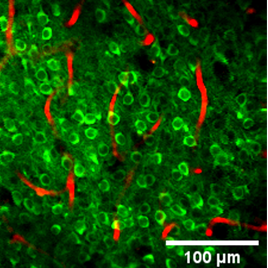
I study how menopause affects brain blood vessels and Alzheimer’s disease risk. During menopause, oestrogen levels fall sharply, and oestrogen normally helps blood vessels dilate and respond to demand from active brain cells. In Alzheimer’s disease, damage to brain blood vessels is one of the earliest changes, occurring up to 25 years before symptoms such as memory loss appear. Using specialised imaging in mouse models, we can directly visualise brain blood vessels (red) and brain cells (green) and track their activity before, during, and after the menopause transition (see image below, taken from: Neurovascular coupling and oxygenation are decreased in hippocampus compared to neocortex because of microvascular differences | Nature Communications).
This research is important because women make up two-thirds of people living with dementia. By understanding why Alzheimer’s risk increases after menopause, we hope to identify early mechanisms of disease and contribute to improving women’s brain health.


Address
Geoffrey Jefferson Brain Research Centre
Clinical Sciences Building
Northern Care Alliance
NHS Foundation Trust
Salford
M6 8FJ
Email: GJBRC@manchester.ac.uk
Connect with us


0 Comments