
Northern Care Alliance to lead £3.4m national study testing whether early treatment can save patients’ hearing
STEREO-VS, an eight-year study sponsored by Northern Care Alliance NHS Foundation Trust and delivered with The University of Manchester, The Christie NHS Foundation Trust and the Nottingham Clinical Trials Unit, will test whether radiosurgery given at diagnosis can prevent hearing loss caused by vestibular schwannoma, a non-cancerous but disabling brain tumour. The study is due to start in November 2026.
Northern Care Alliance NHS Foundation Trust (NCA) has been awarded more than £3.4 million by the National Institute for Health and Care Research (NIHR) to lead a landmark UK-wide clinical trial looking at whether stereotactic radiosurgery (SRS), given at the time of diagnosis, can preserve hearing in patients with vestibular schwannoma (VS).
The eight-year study aims to recruit more than 200 patients with newly diagnosed VS (also known as acoustic neuroma) from up to 16 specialist skull base units across the UK.
Vestibular schwannomas are non-cancerous tumours that grow on the nerve connecting the ear to the brain. They account for around eight per cent of all brain tumours and symptoms include hearing loss, tinnitus, facial palsy and loss of balance.
Most do not grow after diagnosis, so UK patients are currently managed with a ‘watch-and-scan’ approach of regular monitoring rather than immediate treatment. But evidence shows that most patients lose hearing in the affected ear during this time, even when the tumour itself does not grow. This can have a profound and lasting effect on people’s quality of life, relationships, work and career and independence.
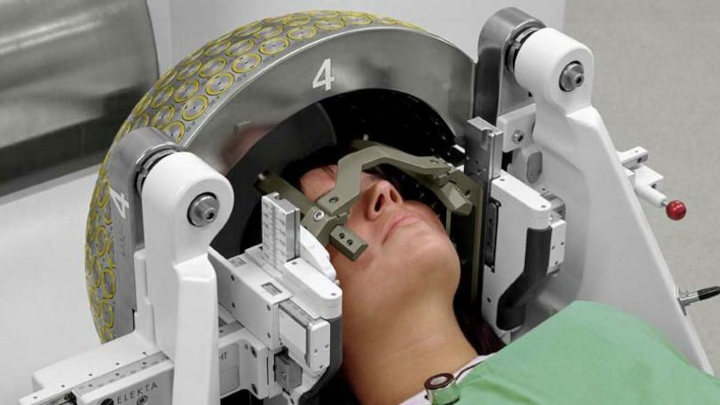
Stereotactic radiosurgery (SRS) – a single outpatient session of highly targeted radiotherapy – is already an established treatment for stopping tumour growth. Some studies suggest that it may also help preserve hearing if given early after diagnosis of a VS. However, other studies of patients whose tumours were managed with a ‘watch-and-scan’ approach suggest the hearing outcomes may be similar. The only way to conclusively establish if early SRS does lead to better hearing outcomes is through a randomised controlled trial.
STEREO-VS will be the first randomised controlled study that seeks to answer this important question of what is best for patient’s hearing and will compare early SRS against standard ‘watch-and-scan’ care over four years of follow-up.
A trial led from one of the UK’s busiest vestibular schwannoma centres
The study is sponsored by NCA and delivered in partnership with The University of Manchester, The Christie NHS Foundation Trust, and the Nottingham Clinical Trials Unit (NCTU) at the University of Nottingham.
NCA is one of the highest-volume centres for the diagnosis and surgical management of vestibular schwannoma in the UK, seeing more than 150 patients with newly diagnosed VS each year, around 10% of new diagnoses.
The trial is co-led by Professor Omar Pathmanaban, Consultant Neurosurgeon at NCA and co-strategic lead at the Geoffrey Jefferson Brain Research Centre, and Professor Kevin Munro, Professor of Audiology at The University of Manchester and honorary Consultant Clinical Scientist at Manchester University NHS Foundation Trust, as co-chief investigators – bringing together audiological and neurosurgical expertise to lead a study that spans both specialties.
Professor Munro is an NIHR Senior Investigator and part of the Hearing Health Theme at the NIHR Biomedical Research Centre (BRC): Manchester. Professor Omar Pathmanaban is also a researcher in the NIHR BRC: Manchester Rare Conditions Theme. Dr Gillian Whitfield from The Christie is the study’s clinical oncologist and radiotherapy lead.
Digits-in-Noise: a REAL-WORLD test at the heart of the trial
Patients have helped to design the study and one of its key features is a ‘real-world’ hearing test measuring speech recognition in background noise. Experts at The University of Manchester have developed a bespoke version of the Digits-in-Noise (DiN) test, which will test how well patients can follow a conversation in a noisy room – something that patients and families say matters most to them.
Unlike traditional hearing tests, DiN does not require specialised equipment and can be completed on a laptop or tablet in clinic or at home.
By using a test that can be completed remotely, the trial team also hopes to lower barriers to taking part for patients who might otherwise struggle, including those in rural and coastal communities and people who live further from the trial centres. The DiN may also benefit those who do not speak English as a first language, as for most people, numbers are one of the first things they learn in another language and so is a much lower barrier to participation, than the need to be able to read English to complete questionnaires.
Designed with and for patients
Co-chief investigator Professor Pathmanaban said: “Patients and carers with lived experience of vestibular schwannoma have played a key role in the design of the study, working alongside co-applicants the British Acoustic Neuroma Association. This means the study reflects their priorities as well as answering clinicians’ questions about effective treatment. Our patient partners helped choose the trial’s outcome measures, including an anxiety questionnaire, and two have joined the study as co-applicants.
“If the trial shows that early SRS preserves hearing, it has the potential to change how vestibular schwannoma is managed across the NHS and internationally. If not, the trial will provide equally important evidence to prevent patients undergoing radiosurgery unnecessarily.”
Patient advisor and co-applicant Sara Crosland said: “Having experienced a vestibular schwannoma myself, I know that hearing loss can have a profound impact on everyday life, affecting relationships, work, social interactions, confidence and independence. I am delighted that this study is focusing on an outcome that matters so much to patients, and I hope it will help identify better ways to preserve hearing and improve quality of life for people diagnosed with vestibular schwannoma in the future.”
Previously, few research studies have used outcomes that are important to people with VS, such as reduction in symptoms.
Improving quality of care
Professor Anthony Gordon, Director of NIHR’s Health Technology Assessment Programme, which is funding the study, said: “Non-cancerous brain tumours like vestibular schwannoma can cause devastating hearing loss, severely restricting peoples’ quality of life and their family relationships. This new NIHR-funded trial aims to test if highly targeted radiotherapy can preserve and prevent patients’ hearing deteriorating any further. Importantly this study includes an online hearing test which can be conducted from the comfort of their own homes.
“For the last two decades, NIHR’s research has aimed to significantly improve the quality of care, helping make the NHS more efficient and effective for everyone.”
Building on Manchester’s neurosurgical research expertise
Recruitment is expected to open in July 2027, with results toward the end of the decade.
The study has been shaped by earlier research led by NCA’s neurosurgical team. Mr Cathal Hannan, a skull base neurosurgery fellow at NCA previously led a review of the current evidence in VS, finding that most studies do not assess hearing in a way that is meaningful to patients.
Mr Daniel Lewis, an NIHR Academic Clinical Lecturer in Neurosurgery, led the feasibility study that underpinned the trial’s design, testing remote digits-in-noise assessment in patients with vestibular schwannoma. He will co-lead knowledge mobilisation alongside Mr Hannan and take a leading role in trial set-up, regulatory and ethical approvals, site recruitment, and the analysis and dissemination of results.
Their contribution reflects a wider pipeline of NIHR- and NHS-supported academic neurosurgical research based at NCA and The University of Manchester, feeding directly into a trial designed to change practice for patients across the UK.
Address
Geoffrey Jefferson Brain Research Centre
Clinical Sciences Building
Northern Care Alliance
NHS Foundation Trust
Salford
M6 8FJ
Email: GJBRC@manchester.ac.uk
Connect with us


0 Comments